Octo
- 184
- Global rank
- 144
- Month rank
- 181
- Week rank
Octo malware, also known as ExobotCompact or Coper, is a sophisticated Android banking trojan that has evolved from earlier malware family Exobot. It poses a significant threat to financial institutions, mobile users, and enterprise networks.
- Trojan
- Type
- Unknown
- Origin
- 1 February, 2021
- First seen
- 28 September, 2026
- Last seen
How to analyze Octo with ANY.RUN
IOCs
IP addresses
- 194.59.31.126
- 176.123.1.132
- 94.74.182.52
- 142.251.151.119
- 142.251.153.119
- 142.251.156.119
- 142.251.154.119
- 142.251.110.102
- 142.251.110.94
- 142.250.154.94
- 142.251.20.94
- 142.251.150.119
- 216.239.35.4
- 142.251.155.119
- 142.251.14.94
- 34.104.35.123
- 142.251.110.100
- 142.251.127.81
- 172.217.117.4
- 142.251.152.119
Hashes
- bb9f8df61474d25e71fa00722318cd387396ca1736605e1248821cc0de3d3af8
- f9d31b278e215eb0d0e9cd709edfa037e828f36214ab7906f612160fead4b2b4
- 8e89bbb65cdd9fffc294660ba897eb044424a9f80306f1f1f165aeea01d9b8ec
- 8b82f6032e29a2b5c96031a3630fb6173d12ff0295bc20bb21b877d08f0812d8
- 6c0f7584f6bbeb0fcaff4626dc2f031e33a2332fa244fbbd1729233be02e5c54
- 822431b5ba851126f85acc263068b595d95190f0db8f7e2c2fdd8f0ee96838d3
- 5a66cb0f25fe5f6d2d0a9057c9b782eae20404dcdf7a017ade45602b06f8bc87
- 3c4af14d27776e1c5146c3784c5ebe6786241d1bc1d5882a43822ba6c1db581d
- e44c6703f8ce2b1ed819f8756b4b888c517095b5ef35917ee916af8318deb3b1
- 6ec886904f5a6041d39304d3b46699d28f0bab12fcdd4446981d0e1df6a35c18
- 08b17ce62c0987278f7c4b56684ebc1a18433dcc1b2e9346f4e0edf03c21ff41
- 063f3565965de1291fe41761620587adac8b337fc4a4ba38592170af97b51be1
- 065bfa94d0d21ba1a1722a26f52731a6512c8f005d56ead13856e91c19bcade4
- e80c0e454a89e4feaa0eb18df6c92efd3e9fe6d0f4c131dd130512aeb7f60020
- 86957584483bcf6dae8085b280b20da11af5ebe4e6824ae4ca1b0ddcffe8d509
- 4a17496b5f81cfe4e0d290cd9bbb6820fb15140664c560eb7918f6d9146215f4
- 1472ab5c93bf9cb22f582b535565efdf0c4be72fabfbd537646e10be728eda11
- 69a464ba66e320797c3bf568975e0062ac92019f755bbf8ac7fcee16d9b6262a
- d5fc42f4d8531eae51ce3d8726bd925da43e4e2e2e860e2b3faf4727432a9775
- af8d008200fc56bf9b96286261f4118962303d90c9d1bb3fa5edc17e73354fc2
Domains
- www.google.com
- connectivitycheck.gstatic.com
- play.googleapis.com
- 344d23b6606asd1211f9813c0c4d18f2a5f.com
- clientservices.googleapis.com
- staging-remoteprovisioning.sandbox.googleapis.com
- google.com
- update.googleapis.com
- time.android.com
- 54623b606ada1211f9813c0c4d18f2a5f.com
- edgedl.me.gvt1.com
- www.ip-api.com
- uauzustttt.com
- fuaggggotc.top
- guuagwuu.top
- thhausgajk.com
- uagggauua.com
URLs
- http://connectivitycheck.gstatic.com/generate_204
- http://play.googleapis.com/generate_204
- https://www.google.com/generate_204
- https://staging-remoteprovisioning.sandbox.googleapis.com/v1:fetcheekchain
- https://staging-remoteprovisioning.sandbox.googleapis.com/v1:signcertificates?challenge=aaaboofzrx4bilsty-c_xrrr_h1zilsmybbwh8i=&request_id=1c1ca05c-9ade-4939-82ac-0c81a57f0027
- https://clientservices.googleapis.com/chrome-variations/seed?osname=android_webview&milestone=137
- https://update.googleapis.com/service/update2/json?cup2key=15:qdh6p4irx0jsmyekk0tsm1ztgieboy7dfmfecktqkho&cup2hreq=12fef204ca88fac17878a773a058b093e6b69624f1672566f4ae8d9cb183af5b
- https://update.googleapis.com/service/update2/json
- https://edgedl.me.gvt1.com/edgedl/release2/chrome_component/acmmwq7dser4xm5sepzjv74g65vq_2023.7.28.10/cffplpkejcbdpfnfabnjikeicbedmifn_2023.07.28.10_all_acgbwixmcanakp2bkoppyszsbkrq.crx3
- https://staging-remoteprovisioning.sandbox.googleapis.com/v1:signcertificates?challenge=aaabooe0bd8bilsty-ogje_codrhxflbxbmvhde=&request_id=56428c47-c146-4eca-a50c-b9bbe120c5e7
- https://update.googleapis.com/service/update2/json?cup2key=15:ilfwkryilu0y58bmhyibdwf058ndduxp3ntrjtprckc&cup2hreq=5deaca71f0d22e7778e4dc912cdbeb6a7435e5bb100e9551f6bcd2536e11b9ee
- http://www.ip-api.com/json
- https://thhausgajk.com/mwnhmji2otkynja3/
- https://thhausgajk.com/mwnhmji2otkynja3/?language=en&model=samsung+galaxy_s9&is_xiaomi=0&is_samsung=1&app=bawag%20psk%20security
- http://www.google.com/gen_204
- https://staging-remoteprovisioning.sandbox.googleapis.com/v1:signcertificates?challenge=aaabnf189csbilstywbvahcows7ctwi3wpfruzs=&request_id=d17110e9-14e7-4114-bfa2-630b22663b5d
- https://update.googleapis.com/service/update2/json?cup2key=15:luiool8oxfs7f0hlrj-bp98aglovoiulxng7yacoemi&cup2hreq=9a05f8d9b8ef18723c5b80e19c78b223cf7c0576dbfaba8254045fa10fd04646
Last seen at
- b4dadf3553bb82499c4d0b6be96c47c46abc6904b611376d75c844ffb83725c6.apk
- 841e432a41b9625040704fd636d4fc3814a6d4193fa315cd78cfed9aa3991c04.apk
- bank.apk
- 9W.apk
- 8166dfba7fd0b4ad44c8bc91cc0e98fa06b8912e3fca2093900eb58ba79d22d4.apk
- Chrome.apk
- Chrome.apk
- Chrome.apk
- Chrome.apk
- dc2a780f6abb9f0ec0a6675f20acb91ebe2a8748297682a59daf9164fbea2ee8.apk
What is Octo malware?
Octo, also known as Coper or ExobotCompact, is an Android banking Trojan that evolved from the Exobot malware family, first observed in 2016. Initially based on the Marcher Trojan, Exobot targeted financial institutions globally until 2018, when a lighter version, ExobotCompact, emerged.
By 2021, a new variant appeared, named Coper by some antivirus vendors, but later renamed as Octo — a rebranded and enhanced ExobotCompact. In 2024, Octo2, an even more advanced iteration, was released, driven partly by the leak of Octo’s source code. The Malware-as-a-Service (MaaS) model makes Octo accessible to even novice cybercriminals.
Lineage:
- Exobot, an Android banking trojan that went inactive, and its source code leaked.
- ExobotCompact, a more compact version with no dependency on older Android APIs.
- Octo, enhanced version with powerful remote access and evasion features.
- Coper is sometimes considered a separate but related strain, circulating in Latin America, sharing infrastructure/code.
Octo’s Distribution
The malware targets Android devices through social engineering and malicious app distribution:
- Fake Apps and Droppers: Octo disguises itself as legitimate apps like Google Chrome, NordVPN, or banking apps, often using a dropper service called Zombinder to bundle with legitimate APKs. These are typically distributed via third-party app stores, malicious websites, or phishing campaigns, though some droppers.
- SMS Phishing (Smishing): Messages with malicious links trick users into downloading fake apps posing as WhatsApp, Netflix, or banking services. This functionality is similar to that of Salvador Stealer, another Android banking trojan.
- Social Engineering: Campaigns often impersonate trusted brands or simulate urgent software updates. Regional targeting, such as fake Bancolombia apps for Colombian users, enhances credibility.
Once installed, Octo prompts users to enable Accessibility Services and give out Device Admin privileges, granting extensive control over the device, and enhances remote access stability.
Its communications with C2 servers include dynamic configurations to target specific apps (e.g., to block push notifications from banking apps).
Octo’s Key Operation Vectors
- Keylogging: to capture credentials, PINs, and lock patterns. Data is temporarily stored in the device’s data directory before deletion to avoid detection.
- Overlay Attacks: the trojan displays fake login screens or overlays mimicking banking apps to steal credentials and card details. Overlays adapt dynamically to the active app, increasing deception.
- SMS and Notification Interception: Intercepts messages and push notifications, enabling attackers to bypass two-factor authentication (2FA).
- Remote Access (VNC): Uses Android’s MediaProjection for near-real-time screen streaming (1 screenshot per second. Sends live feed to C2, allowing attackers to see everything that happens on the device.
- Device Takeover: Can simulate clicks and actions in real-time.
- Ransomware-Like Locking: Some variants (like Coper) can lock screens and demand ransom.
Why Octo Is Especially Dangerous
- Full Remote Control of Mobile Devices.
- Live Monitoring and Fraud: Attackers perform fraud while victims are active, bypassing behavioral fraud detection.
- Two-Factor Authentication Bypass: Through SMS or code-grabbing overlays.
- Modular Structure: Can load updated components from C2 without user knowing.
- Enterprise Risk: Can be used as an entry point into corporate networks via compromised employee devices (BYOD); targets banking customers and employees.
Octo’s Execution Process and Evasion Techniques
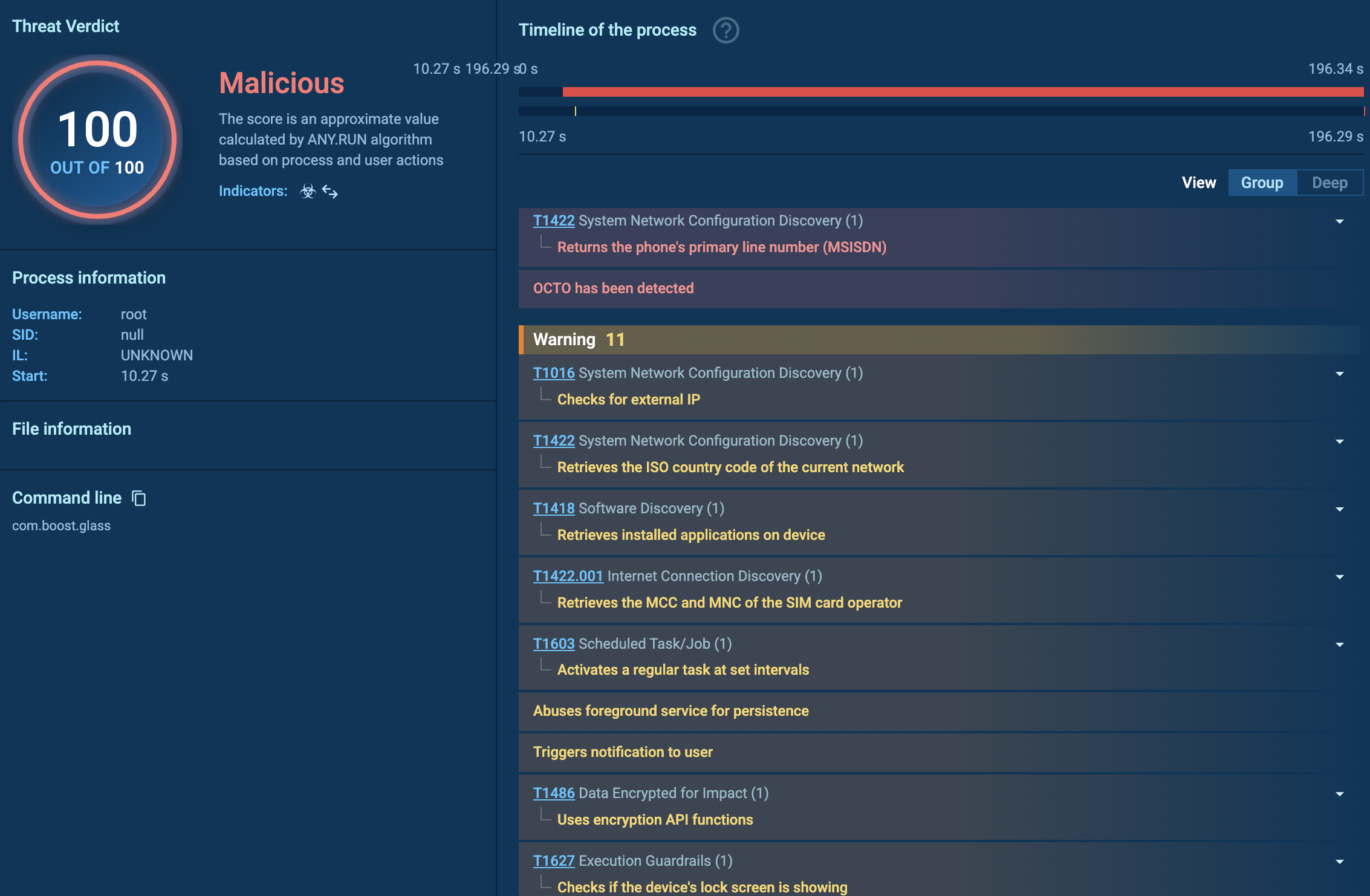
ANY.RUN’s Interactive Sandbox supports the analysis of APK files and enables the research of Android malware. Let us observe the behavior of an Octo sample where the malware is disguised as Google Chrome browser.
View Octo analysis session in the Sandbox
Once installed, Octo — also known as Coper or ExobotCompact — connects to its command and control (C2) server, potentially using a domain generation algorithm (DGA) to maintain resilient, encrypted communication. In our case, the address was toplamakampiyolculukhazirlik[.]xyz, visible in the DNS requests tab, though unresolved. The C2 provides configuration files and commands specifying which apps to target and what actions to take. In this task, the C2 was already offline.
Octo abuses Android’s Accessibility Service and MediaProjection APIs to gain full remote control, enabling real-time screen streaming, simulated taps, gestures, clipboard access, and text input. To stay hidden, it can display a black screen, dim brightness to zero, and disable notifications.
The malware supports keylogging, SMS and notification interception, blocking app alerts, screen locking/unlocking, muting sound, launching apps, and sending SMS. Attackers use AES-encrypted, Base64-encoded commands to control these features and perform on-device fraud—initiating and confirming transactions without triggering alarms.
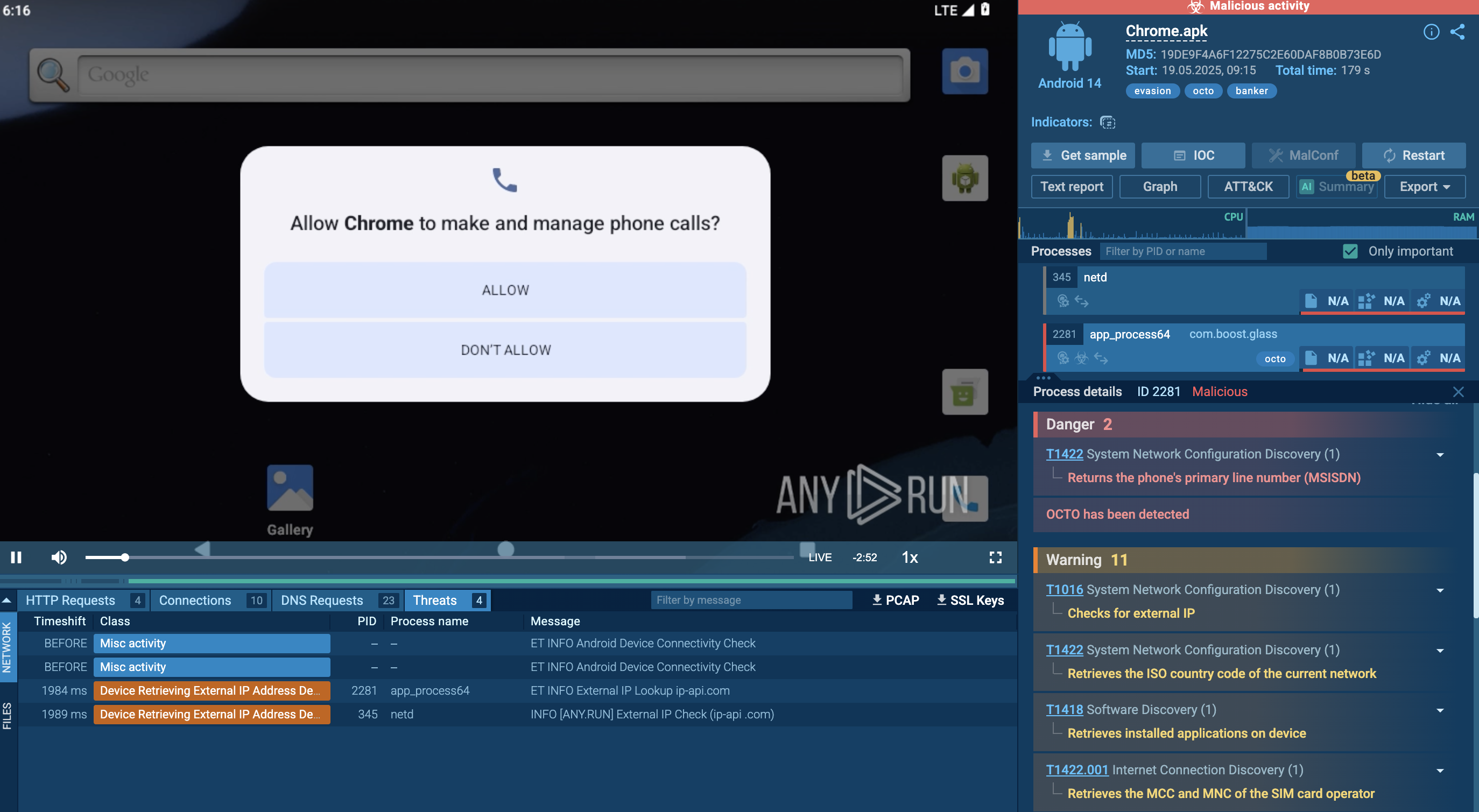
Octo can also inject fake overlays to steal credentials and uninstall competing or security apps to maintain persistence and avoid detection.
This malware employs advanced methods to avoid detection. It requires no root access using Accessibility Services for control. Its small, modular codebase demonstrates a lightweight footprint helping to avoid detection by traditional antiviruses. Besides, obfuscation is applied, along with multi-layered code encryption, dynamic loading of malicious libraries. Continuous updates by developers and forks from the 2024 source code leak keep Octo ahead of traditional detection methods.
What are the best-known Octo attacks?
While many campaigns are not publicly attributed due to the nature of mobile malware distribution, several have been documented by security vendors and researchers.
| Year | Campaign / Actor | Region | Method | Targets |
|---|---|---|---|---|
| 2022 | Coper (Octo variant) | Latin America | Fake banking apps, smishing | Colombian & Peruvian banks |
| 2022 | Octo advertised on dark web | Global | Malware-as-a-Service (MaaS) | European banks |
| 2022 | Fake Chrome Update | Global | Smishing, fake update | Generic users, credential theft |
| 2022–23 | Google Play fake apps | Global | Dropper apps | Banking and crypto users |
Gathering Threat Intelligence on Octo malware
Octo can be detected by such indicators as C2 domains, IPs, and unusual DNS traffic. Among the behavioral indicators, analysts should pay attention to background services that relaunch on boot, the use of Accessibility APIs, and unexpected overlays over banking apps. Its APK signatures include package names often mimicking known apps and typical permissions requests, like SYSTEM_ALERT_WINDOW, BIND_ACCESSIBILITY_SERVICE.
To start gathering actionable data via ANY.RUN's Threat Intelligence Lookup, search for the malware name and its aliases:
threatName:"octo" OR threatName:"exobot*"
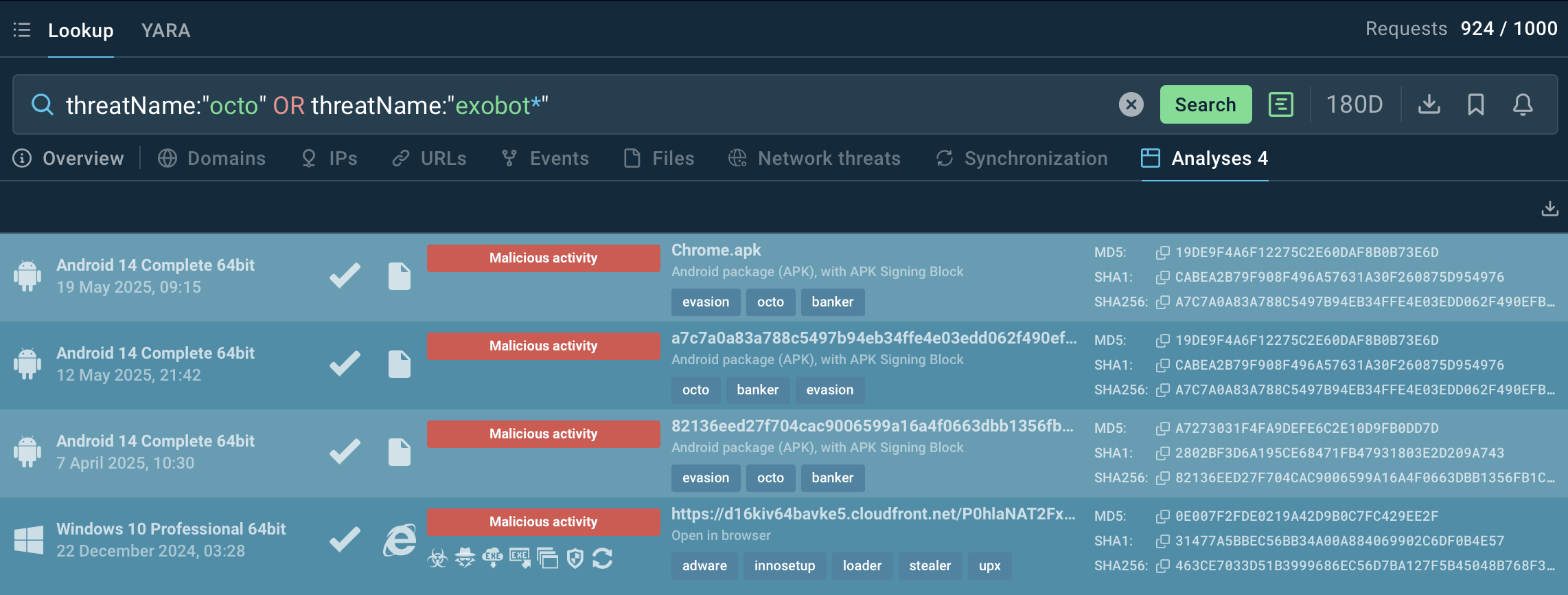
Select and view analysis sessions to collect IOCs, IOBs, view processes, and study the malware’s TTPs to set up detection and response system, to develop prevention and mitigation strategies.
Conclusion
Octo malware (ExobotCompact / Coper) is one of the most advanced mobile threats in circulation, particularly dangerous because it provides real-time remote access and can bypass many layers of authentication and fraud detection. While it mainly targets banking users, its modularity and stealth make it a viable tool for cybercrime groups and potential APT-style attacks against enterprises. Countering Octo demands robust threat intelligence, proactive user education, and strict device security practices.
Start with 50 requests in TI Lookup to collect IOCs on the evolving Android malware
Other malware & phishing threats
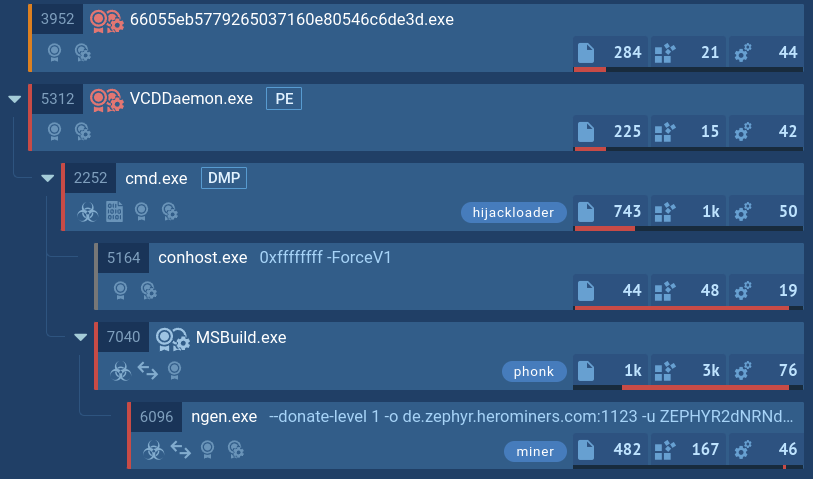 HijackLoaderHijackLoader is a modular malware acting as a vehicle for distributing different types of malicious software on compromised systems. It gained prominence during the summer of 2023 and has since been used in multiple attacks against organizations from various sectors, including hospitality businesses.
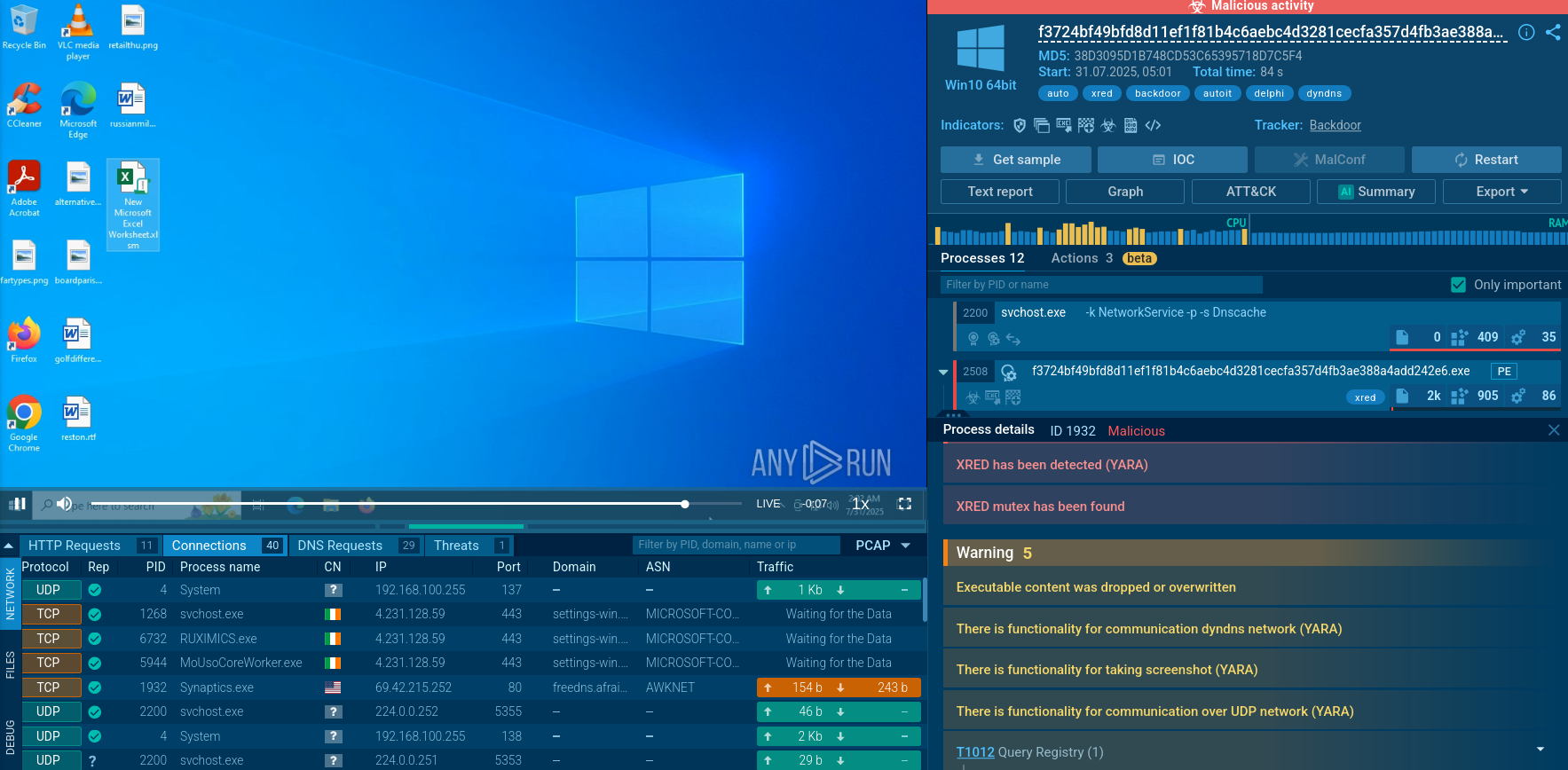 XRedXRed operates as a stealthy backdoor, enabling cybercriminals to gain unauthorized remote access to infected systems. XRed has gained particular notoriety for its distribution through trojanized legitimate software and hardware drivers, making it exceptionally dangerous due to its ability to masquerade as trusted applications.
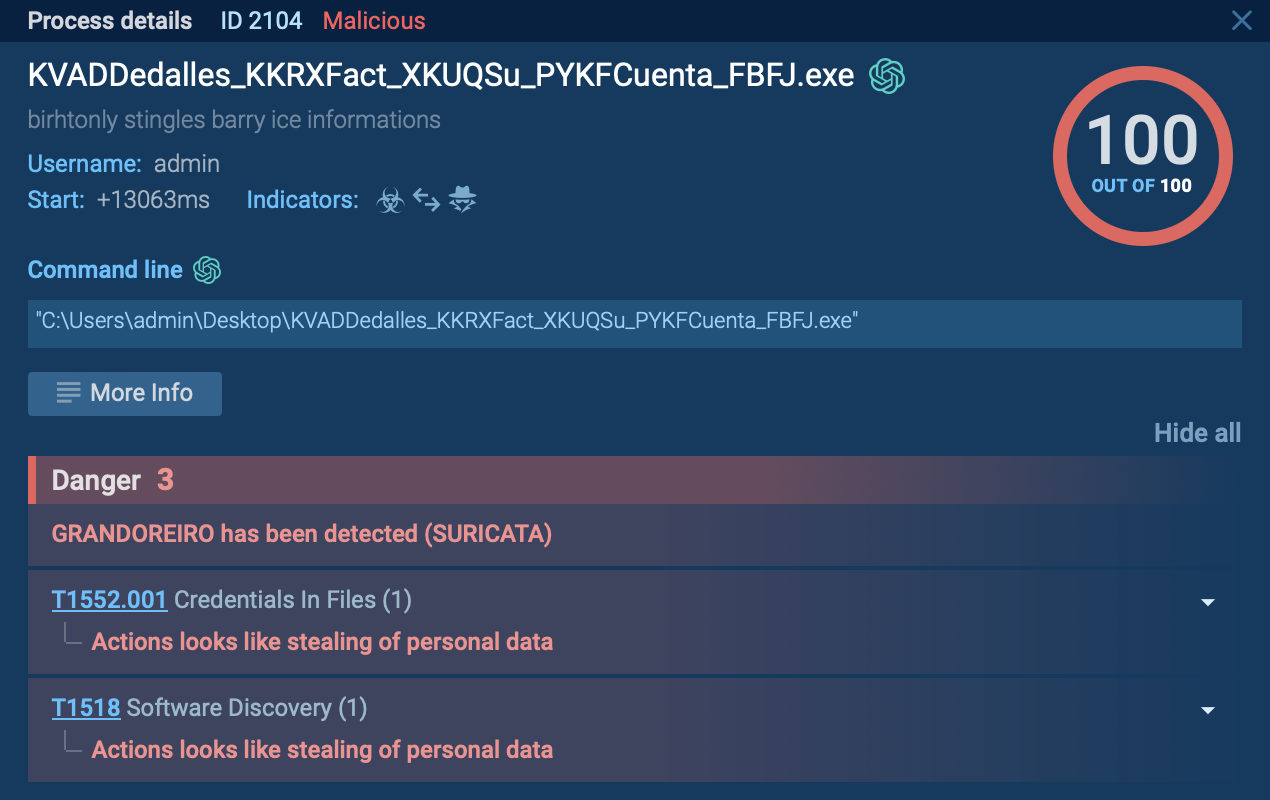 GrandoreiroGrandoreiro is a Latin American banking trojan first observed in 2016. It targets mostly Spanish-speaking countries, such as Brazil, Spain, Mexico and Peru. This malware is operated as a Malware-as-a-Service (MaaS), which makes it easily accessible for cybercriminals. Besides, it uses advanced techniques to evade detection.
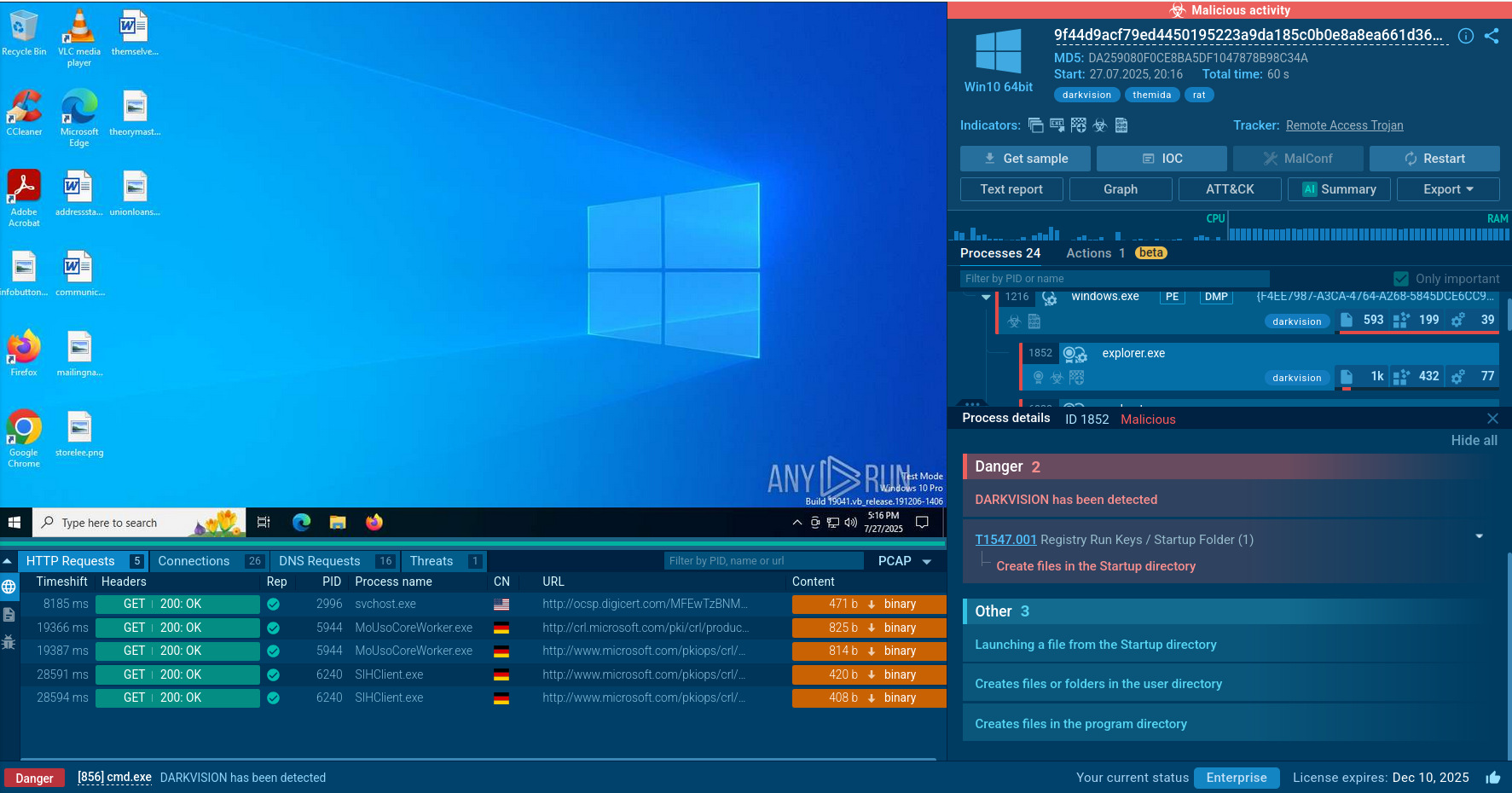 DarkVisionDarkVision RAT is a low-cost, modular Remote Access Trojan that gives attackers remote control of infected Windows hosts. Initially observed around 2020 and sold in underground marketplaces, DarkVision has become notable for its full feature set (keylogging, screen capture, file theft, remote command execution and plugin support) and for being distributed via multi-stage loaders in recent campaigns.
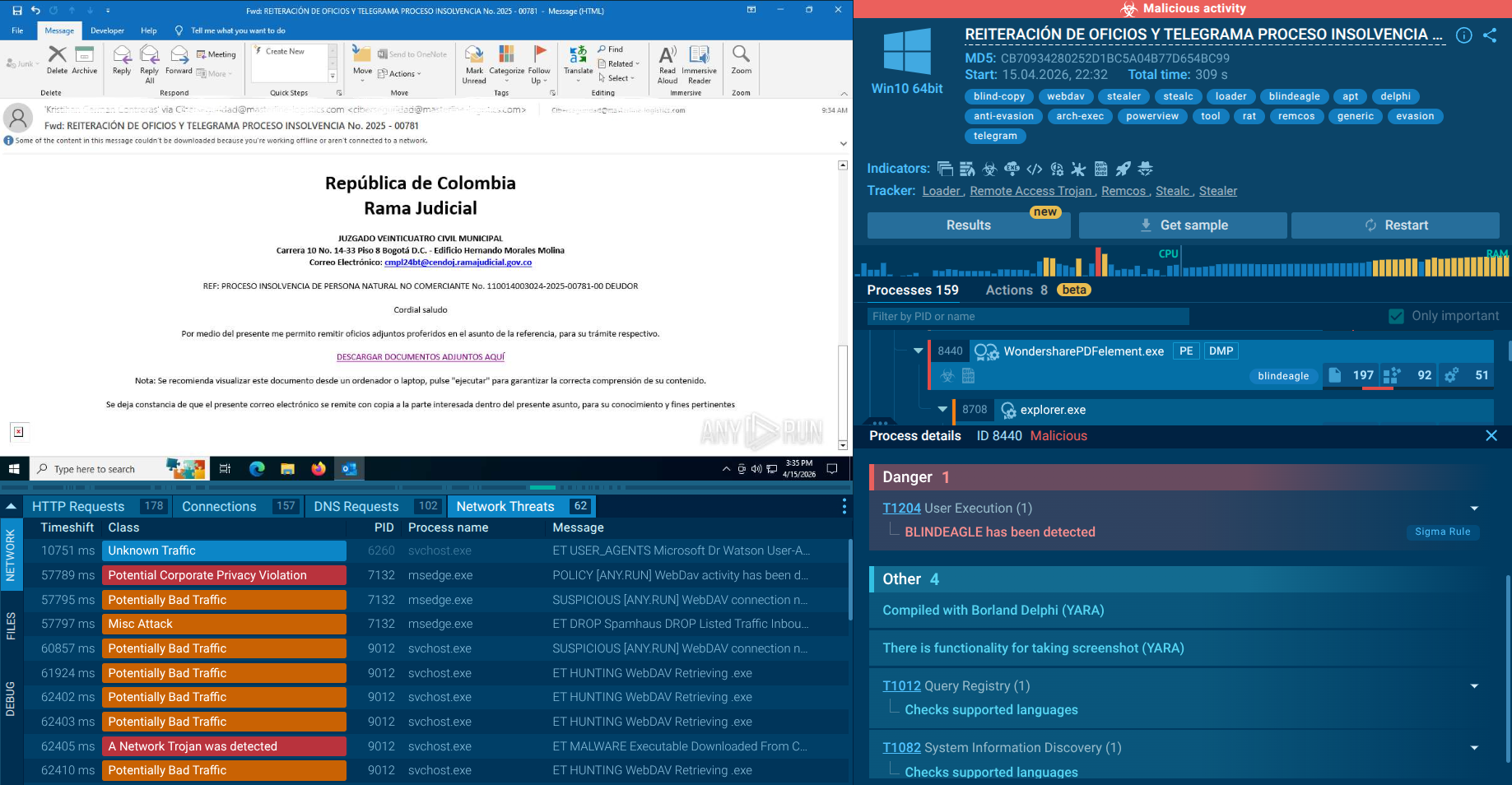 BlindEagleBlindEagle is a cyber threat actor primarily associated with espionage and credential theft campaigns targeting organizations in Latin America, especially Colombia. Active since at least 2018, the group relies heavily on phishing, remote access trojans (RATs), PowerShell scripts, and social engineering to infiltrate systems and maintain persistence. BlindEagle is known for continuously evolving its delivery mechanisms and malware stack to bypass detection and compromise high-value targets.
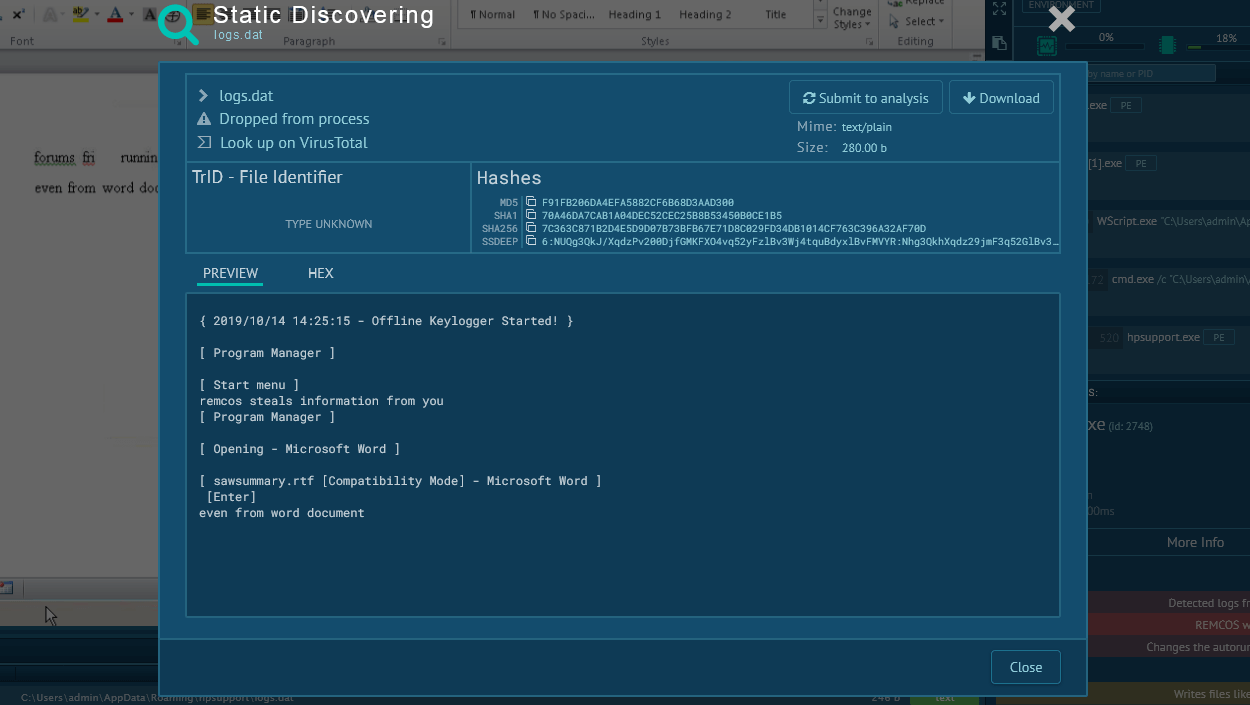 RemcosRemcos is a commercially distributed remote administration and surveillance tool that has been widely observed in unauthorized deployments, where threat actors use it to perform remote actions on compromised machines. It is actively maintained by its vendor, with new versions and feature updates released on a frequent, near-monthly basis.