DragonForce
- 104
- Global rank
- 72
- Month rank
- 109
- Week rank
DragonForce is a ransomware strain operating under the Ransomware-as-a-Service (RaaS) model. First reported in December 2023, it encrypts files with ChaCha8, renames them with random strings, and appends “.dragonforce_encrypted.” By disabling backups, wiping recovery, and spreading across SMB shares, DragonForce maximizes damage and pressures victims into multimillion-dollar ransom negotiations. It has targeted manufacturing, construction, IT, healthcare, and retail sectors worldwide, making it a severe threat to modern enterprises.
- Ransomware
- Type
- Unknown
- Origin
- 1 December, 2023
- First seen
- 16 October, 2026
- Last seen
How to analyze DragonForce with ANY.RUN
IOCs
IP addresses
- 23.59.17.18
- 118.194.235.187
- 23.11.40.157
- 172.217.115.4
- 107.174.192.179
- 185.156.72.2
- 149.154.167.99
- 82.29.67.160
- 8.8.8.8
- 142.251.154.120
- 23.3.89.122
- 139.99.85.213
- 142.251.14.154
- 154.23.184.57
- 104.26.13.64
- 147.185.221.20
- 192.169.69.25
- 213.180.204.127
- 188.114.97.3
- 158.101.44.242
Hashes
- 74441313bb1fb62500484443c4937e90d4e335351a4fcd12a9ac48448500e33e
- a17fcf0a2f50e2d495e4f90ce263410edc183add6c62699a2facbccf60410f74
- 4094d158e3b0581ba433a46d0dce62f99d8c0fd1b50bb4d0517ddc0a4a1fde24
- 99653a38c445ae1d4c373ee672339fd47fd098e0d0ada5f0be70e3b2bf711d38
- c158322bd963d2a68ffc878d72213a7394d8c16de72279771ffc924365eec0df
- 59345c006cd9bde5ef532aae1f119758d45030993181c272bb0dd6fc0c5d01e5
- 2ae1142b08d296c25000e451237ea919f981da28f6a723d39540f43f18bac762
- 5639c845d56dedecd2cfdb082b734593b5d618a87f1bd8ec612a8b3f4245566a
- 32ae9531405ef3c59448fe6dbd3be435e726eb17f3ca0d16530a4c6317dea286
- 7c68f28c6995f47dd77596bab28c6b4388ff93840c3becfd37733ddb640cd0cd
- 40cf1af5650b699a947899d2b43a00dcb64cdeaf080651c82a7930910c1c03f4
- ec249b0dab6fda20cc24f0f25a504c55a05b23fb6cbb4938aa7a41df0c8744b6
- 0162159b64eb092f94964faf937f263fb9947b25d40e0d82bd3224d136a140de
- 77eed9211cd8464482f0da3fac4c0f003c2b8a6d76f15445927e66400f102d60
- 6558013f984e594bb57534910ce0b17bfa15da3cc9bb4b6e0b5c6e4ddf9eb14e
- a7109b8374dffa7a0cd69558990f7e96fea9ef61736d89043dad5a6694cdfa4a
- 758a0b404b3daadbd0d4e88a0bedf5c21d5507392f7b54d4906ffea49d58ab32
- 558bbe6193a202dcb00cc441421f5d838764e495b8e4d2e10877db7f661b8cd5
- db3ac1fd3d65df45d805adb8dfe0c5209db07ef93406db17dfb783dd8048720a
- 19acfa0adce363a9c9a3be73f5ec0fac0dcf3c630ce18125fd265040ad6ffb6c
Domains
- gcc-prtnrs.top
- fonts.googleapis.com
- copilot.microsoft.com
- uploadnow.io
- slscr.update.microsoft.com
- settings-win.data.microsoft.com
- overcovtcg.top
- a.nel.cloudflare.com
- www.bing.com
- www.microsoft.com
- ecs.office.com
- fe3cr.delivery.mp.microsoft.com
- edge-cloud-resource-static.azureedge.net
- self.events.data.microsoft.com
- 17.aa.4t.com
- tpc.googlesyndication.com
- steamcommunity.com
- api.telegram.org
- grabify.link
- ep1.adtrafficquality.google
URLs
- http://crl.microsoft.com/pki/crl/products/microoceraut2011_2011_03_22.crl
- http://www.microsoft.com/pkiops/crl/microsoft%20secure%20server%20ca%202026.crl
- http://ocsp.digicert.com/mfewtzbnmeswstajbgurdgmcgguabbtrjrydryt%2bapf3gspypfhbxr5xtqqus9tippmhxdiunkhmewnpyim8s8yceajtxtab8my1oj8mfwpz%2f7y%3d
- http://oneocsp.microsoft.com/ocsp/mfqwujbqme4wtdajbgurdgmcgguabbq3l3%2f%2fa6adk8nray2gxzvayrhg4aqub6t%2b2v%2bxq3lso2d33ojhnyhhqoucezmaaaafuwohyjguzpcaaaaaaau%3d
- http://edge.microsoft.com/browsernetworktime/time/1/current?cup2key=2:zsvjmdwgmfp10k6ozvn47jh9_ceh_qzpffgux1pd2xc&cup2hreq=e3b0c44298fc1c149afbf4c8996fb92427ae41e4649b934ca495991b7852b855
- https://copilot.microsoft.com/c/api/user/eligibility
- https://config.edge.skype.com/config/v1/edge/133.0.3065.92?clientid=4489578223053569932&agents=edge%2cedgeconfig%2cedgeservices%2cedgefirstrun%2cedgefirstrunconfig&osname=win&client=edge&channel=stable&scpfre=0&osarch=x86_64&osver=10.0.19045&wu=1&devicefamily=desktop&uma=0&sessionid=72&mngd=0&installdate=1661339457&edu=0&soobedate=1504771245&bphint=2&fg=1&lbfgdate=1792145170&lafgdate=0
- https://api.edgeoffer.microsoft.com/edgeoffer/pb/experiments?appid=edge-extensions&country=us
- https://uploadnow.io/en/share?utm_source=0bcds7g
- https://cdn.uploadnow.io/_next/static/css/5117ad1bbac15a06.css
- https://cdn.uploadnow.io/_next/static/css/bdb3e22b41fb00da.css
- https://cdn.uploadnow.io/_next/static/css/56b52b0051b23322.css
- https://cdn.uploadnow.io/_next/static/css/5ded0d5ca9ecc5c1.css
- https://cdn.uploadnow.io/_next/static/chunks/webpack-601ccb16b36d1888.js
- https://cdn.uploadnow.io/_next/static/chunks/framework-76034876ab87df27.js
- https://cdn.uploadnow.io/_next/static/chunks/main-8d1cee1b5c7f376f.js
- https://cdn.uploadnow.io/_next/static/chunks/pages/_app-090ad369d35c5500.js
- https://cdn.uploadnow.io/_next/static/chunks/62867-3e700a701aca7086.js
- https://cdn.uploadnow.io/_next/static/chunks/38993-242fdc22cc1c9823.js
- https://cdn.uploadnow.io/_next/static/chunks/41480-2bfa855128527ec4.js
Last seen at
What is DragonForce Ransomware?
DragonForce is a ransomware strain operating under the Ransomware-as-a-Service (RaaS) model. First observed in December 2023, it encrypts victim files and demands ransom for decryption keys. DragonForce quickly locks both local and network data while simultaneously disabling recovery options, maximizing pressure on the victim.
Its victims span industries such as manufacturing, construction, IT, healthcare, and retail; sectors where encryption of critical data can halt business operations entirely. Ransom demands vary from hundreds of thousands to millions of dollars, determined by the attackers after assessing the victim’s size and revenue. DragonForce operators also employ double extortion, stealing sensitive data before encryption and threatening to leak it if the ransom is not paid.
DragonForce Victimology
DragonForce does not strike randomly, it chooses victims where disruption brings maximum leverage.
- Preferred sectors: Manufacturing, healthcare, IT, construction, and retail.
- Targeting method: Victims are assessed by size and revenue, with ransom demands adjusted accordingly.
- Tactics: Double extortion (data theft + encryption) ensures both operational and reputational pressure.
- Geography: Attacks have been reported in North America, Europe, and Asia, showing a broad targeting scope rather than focusing on a single region.
DragonForce Typical Attack Chain
There are numerous DragonForce ransomware samples detonated in ANY.RUN’s Interactive Sandbox and analyzed by SOC teams worldwide. Let’s walk through how a typical infection unfolds.
View analysis session with DragonForce
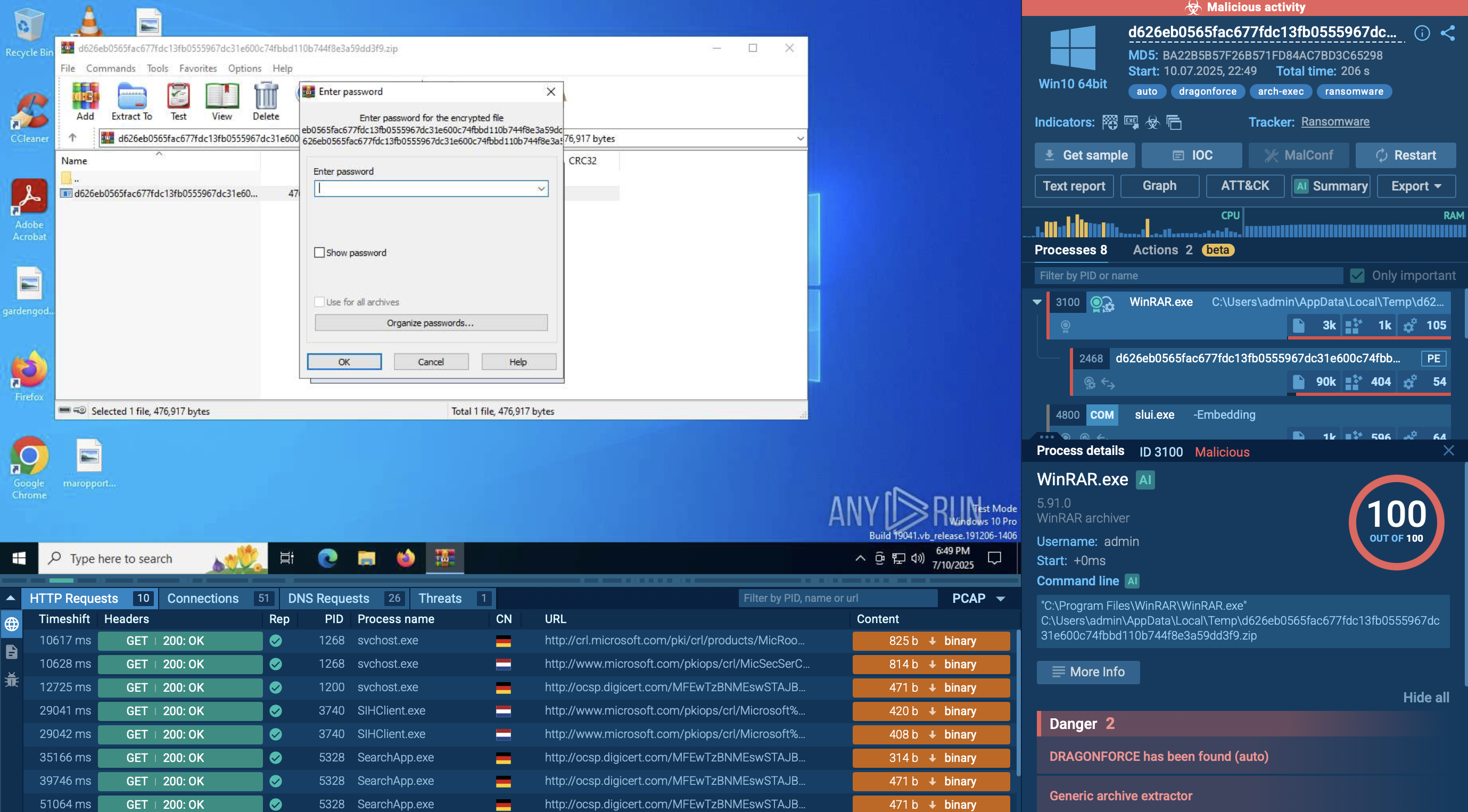
Once launched, DragonForce first checks the environment for virtual machines and debuggers to avoid analysis. It then creates a unique mutex to prevent reinfection and copies itself into the system directory. Persistence is established by registering for autorun and creating scheduled tasks that ensure execution on reboot.
Next, the ransomware escalates privileges by bypassing UAC and modifying PowerShell settings (ExecutionPolicy Bypass) so its scripts can run without restriction. During the preparation phase, DragonForce deletes shadow copies (vssadmin), removes system backups (wbadmin), disables the Windows Recovery Environment (reagentc), and alters boot configuration (bcdedit) to prevent recovery.
In parallel, it uses taskkill.exe, sc.exe, and net.exe to terminate processes and services that could interfere with encryption, including antivirus tools, SQL databases, and mail servers.
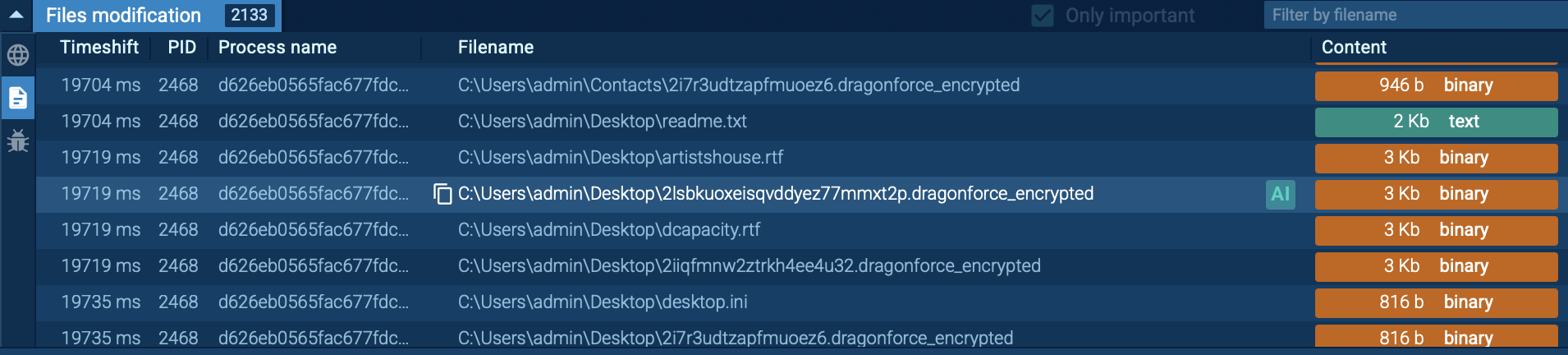
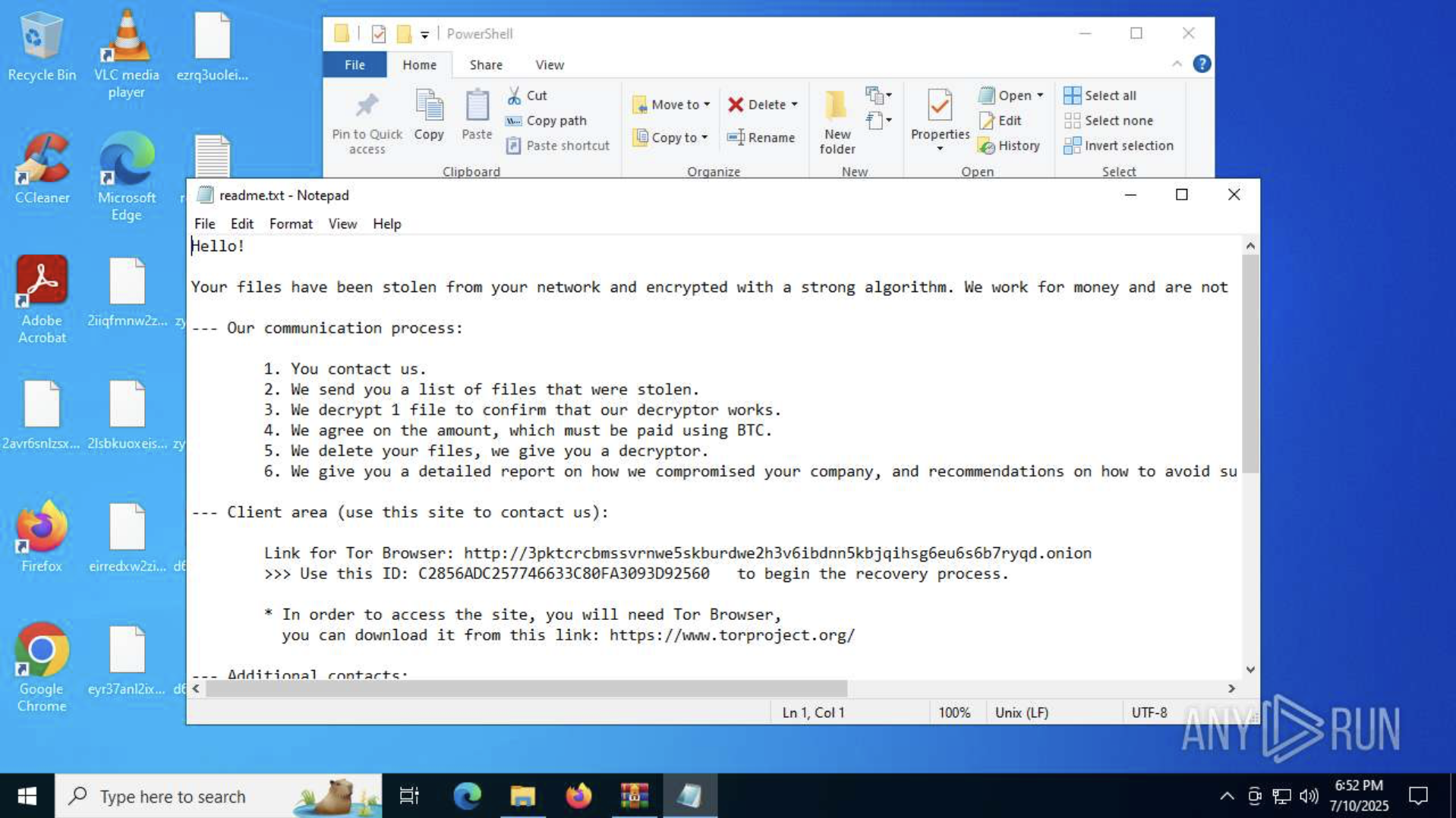
Finally, DragonForce scans local disks, network folders, and NAS devices for files to encrypt. All discovered data is locked with the “.dragonforce_encrypted” extension, and ransom notes (readme.txt) are left in every affected directory with payment instructions.
What DragonForce Can Do to a System
DragonForce primarily targets Windows environments (Windows 10/11 and server editions), with support for 64-bit systems and domain-based network resources. Variants have also been observed for Linux and VMware ESXi, signaling the group’s intent to disrupt entire enterprise infrastructures.
The malware executes with the privileges of the current user but actively attempts to escalate to administrative rights. It bypasses User Account Control (UAC), disables protections, and ensures uninterrupted execution even in environments with weak or misconfigured defenses.
- Stealth and Masquerading: DragonForce hides its activity by running under the names of legitimate Windows processes such as dllhost.exe, audiodg.exe, cmd.exe, conhost.exe, sc.exe, and sppsvc.exe. Copies are placed in the System32 directory to blend in with trusted files. It also creates a unique mutex to prevent reinfection and, in some cases, registers a fake service binary (UI0Detect.exe) to make malicious processes appear like genuine system services.
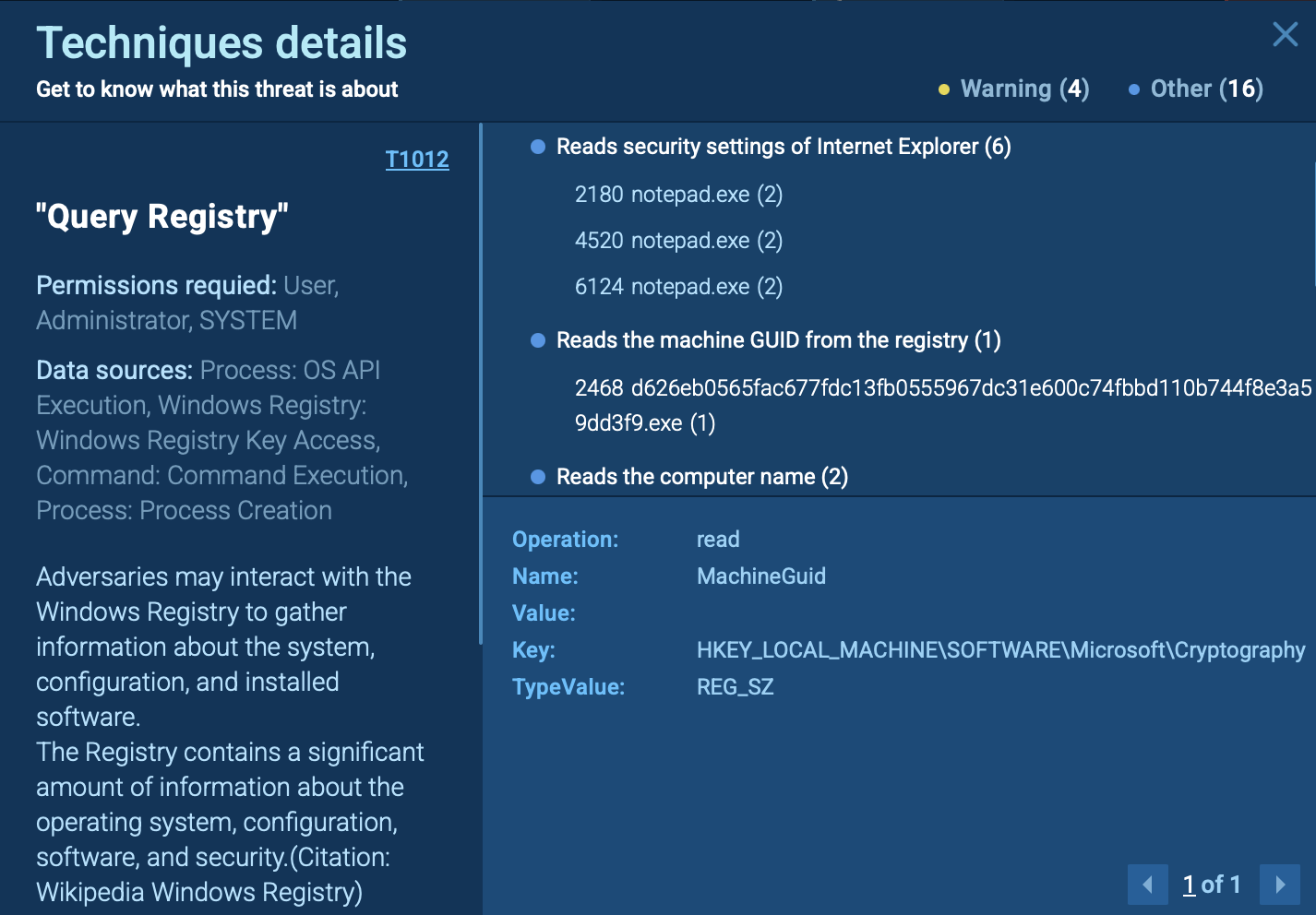
- System Reconnaissance: The ransomware gathers key identifiers such as the computer name and Machine GUID, then scans both local and network resources for files and accessible hosts. This step helps it map the environment before encryption.
- Privilege Escalation: DragonForce bypasses UAC to execute commands with elevated privileges. One method involves abusing slui.exe (Windows Activation Client) together with rundll32.exe to load a COM object and perform a UAC bypass. It also changes PowerShell’s execution policy to Bypass, ensuring its scripts run without restriction.

- Persistence: To maintain access, DragonForce places its copies in System32 under system-like filenames and creates scheduled tasks that trigger on reboot. It can also register or reactivate Windows services such as Interactive Services Detection, linking them to attacker-controlled binaries so the ransomware starts automatically with the system.
- Recovery Elimination: DragonForce systematically removes recovery options. It deletes shadow copies via vssadmin or WMI, removes backups with wbadmin, disables the Windows Recovery Environment with reagentc, and modifies boot settings through bcdedit. It also clears Windows event logs and temporary files to hide traces of its activity.
- Service and Process Control: The ransomware forcibly closes applications that might block access to files. Using taskkill.exe and sc.exe, it stops antivirus programs, SQL databases, and mail servers, clearing the way for uninterrupted encryption.
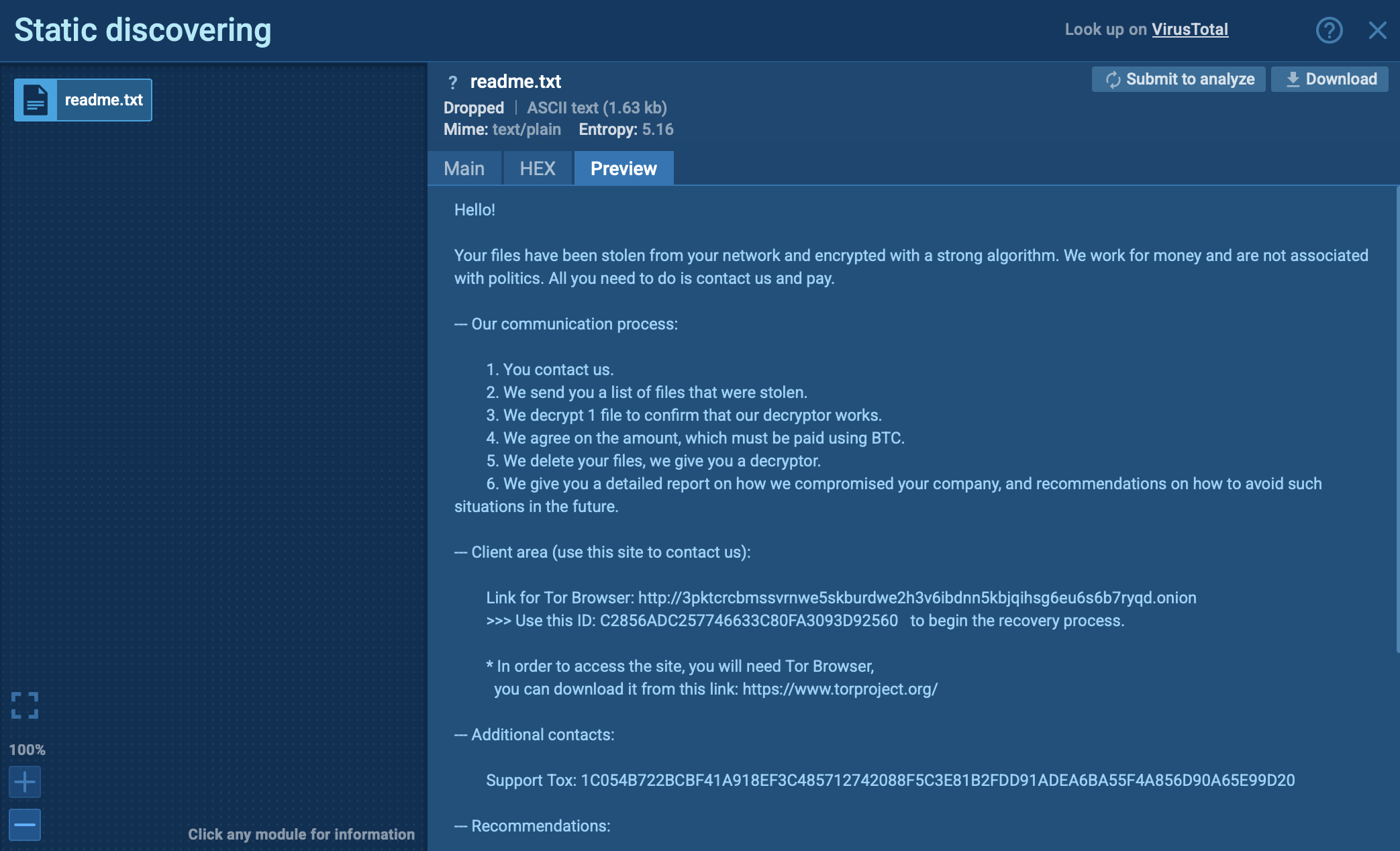
- Encryption: DragonForce encrypts files with the ChaCha8 algorithm. Once locked, files are renamed with random strings and appended with the extension “.dragonforce_encrypted”. A ransom note (readme.txt) is dropped into directories containing encrypted data, instructing victims on how to pay.
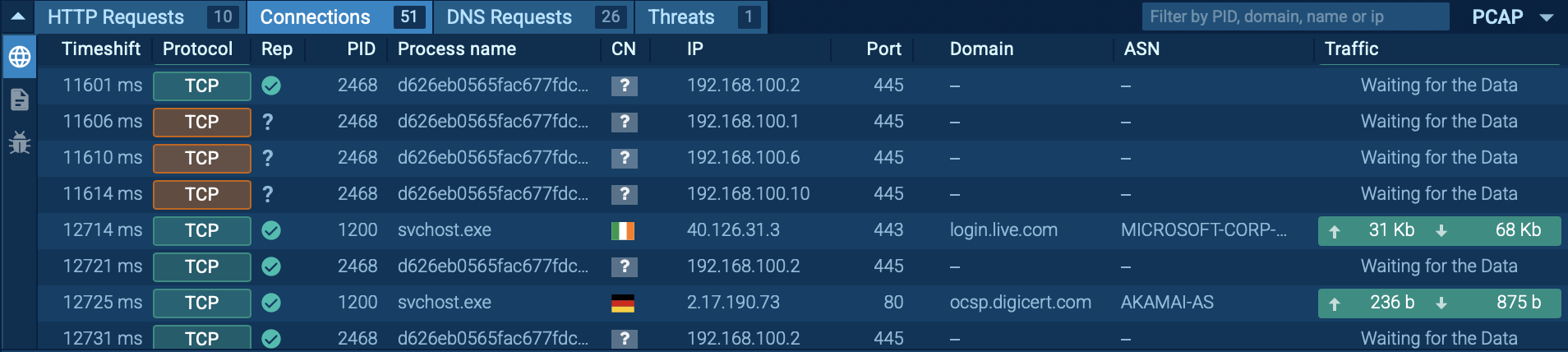
- Network Activity: Beyond local systems, DragonForce scans SMB shares and network devices, attempting to spread laterally across the network. By targeting additional hosts, it maximizes impact across entire corporate environments.
How DragonForce Functions
DragonForce is designed for speed, persistence, and maximum disruption. After gaining elevated privileges and disabling recovery options, it quickly encrypts both local and network data using the ChaCha8 algorithm. By renaming files, erasing backups, and spreading across SMB shares, it ensures that victims are left with no recovery path other than ransom negotiations.
How DragonForce Threatens Businesses and Organizations
DragonForce ransomware is engineered to cause rapid and large-scale disruption, leaving organizations with few options beyond ransom negotiations. Its threat profile extends beyond encrypted files to broader operational, financial, and reputational risks.
- Business Paralysis: By encrypting local files, network shares, and NAS devices, DragonForce can halt production lines, disrupt IT services, and cut off access to critical business data across entire enterprises.
- Loss of Recovery Options: Through systematic deletion of backups, shadow copies, and recovery environments, DragonForce removes every built-in safety net, forcing businesses into ransom negotiations if offline backups are not available.
- Double Extortion Pressure: Attackers steal sensitive data before encryption, threatening to leak intellectual property, customer records, or financial information if the ransom is not paid. This creates both an operational crisis and a compliance challenge.
- Cross-Platform Risk: With variants targeting Windows, Linux, and VMware ESXi, DragonForce is capable of disrupting mixed and virtualized infrastructures, including data centers and cloud environments.
- Financial and Reputational Damage: Ransom demands can reach millions of dollars, and even if paid, victims face regulatory scrutiny, customer distrust, and long-term brand damage.
Gathering Threat Intelligence on DragonForce
Integrating threat intelligence into security operations is important for detecting and mitigating DragonForce attacks. Threat intelligence provides updated indicators of compromise (IOCs), such as malicious file hashes, domains, and network behaviors, which can be used to block activity and uncover infections before encryption begins.
It also supports proactive threat hunting, enabling SOC teams to detect DragonForce based on its known behaviors, including UAC bypass attempts, registry changes for persistence, recovery elimination with tools like vssadmin and wbadmin, and lateral movement through SMB scanning.
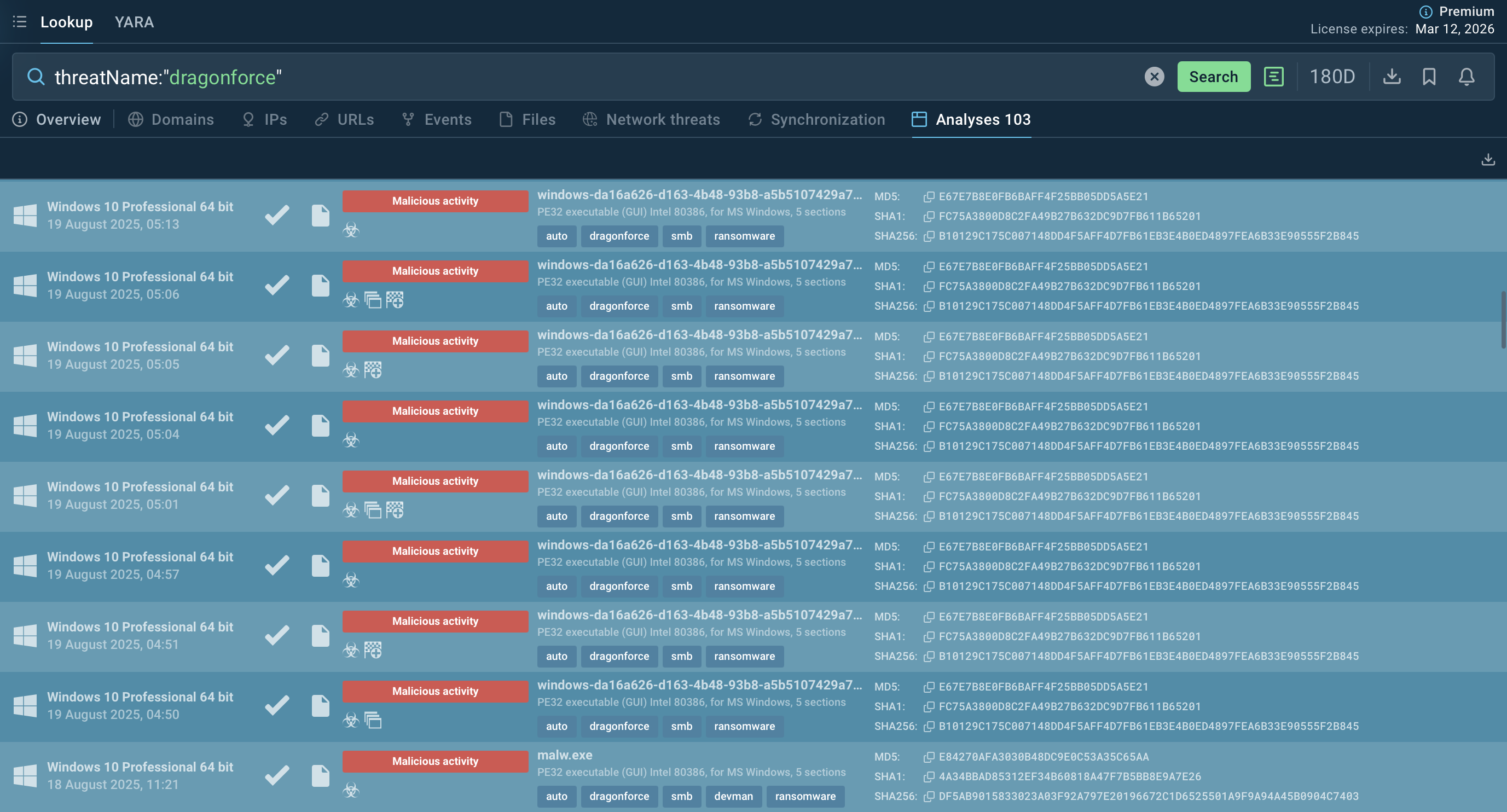
Start gathering IOCs and behavioral data with the malware name search request to Threat Intelligence Lookup:
Conclusion
DragonForce is a destructive ransomware strain built to paralyze organizations. By wiping recovery options, escalating privileges, and encrypting both local and network data with ChaCha8, it leaves victims with no easy way out. The added pressure of double extortion makes it a severe risk for both operations and reputation.
To defend against it, security teams need early detection of behaviors like shadow copy deletion, UAC bypass, and SMB scanning, well before encryption begins. Actionable threat intelligence from ANY.RUN’s TI Lookup helps SOCs spot these patterns and respond faster.
Gather fresh intelligence via ANY.RUN’s TI Lookup: start with 50 trial requests.
Other malware & phishing threats
 GravityRATGravityRAT is a sophisticated spyware and remote access trojan that has been actively targeting organizations and government entities since 2016. It uses innovative anti-analysis techniques and made an evolution from a Windows-only threat to a cross-platform espionage tool capable of compromising Windows, Android, and macOS systems.
 DarkVisionDarkVision RAT is a low-cost, modular Remote Access Trojan that gives attackers remote control of infected Windows hosts. Initially observed around 2020 and sold in underground marketplaces, DarkVision has become notable for its full feature set (keylogging, screen capture, file theft, remote command execution and plugin support) and for being distributed via multi-stage loaders in recent campaigns.
 SSLoadSSLoad is a malicious loader or downloader that is used to infiltrate target systems through phishing emails, perform reconnaissance and transmit it back to its operators delivering malicious payloads. To avoid detection, SSLoad employs various encryption methods and delivery techniques highlighting its versatile nature and complexity. It is believed to be a part of Malware-as-a-Service (MaaS) operation given its diverse delivery methods and implemented techniques.
 Bert RansomwareBert Ransomware is a newly emerged ransomware group that has been active since April 2025. It deploys variants targeting both Windows and Linux systems, focusing on critical sectors like healthcare, technology, and event services across the US, Asia, and Europe.
 DharmaDharma is advanced ransomware that has been observed in the wild since 2016. It is considered to be the second most profitable RaaS operation by the FBI. The malware targets hospitals and state organizations, encrypts files, and demands a payment to restore access to lost information.
 DarkTortillaDarkTortilla is a crypter used by attackers to spread harmful software. It can modify system files to stay hidden and active. DarkTortilla is a multi-stage crypter that relies on several components to operate. It is often distributed through phishing sites that look like real services.